


...

Braille sign

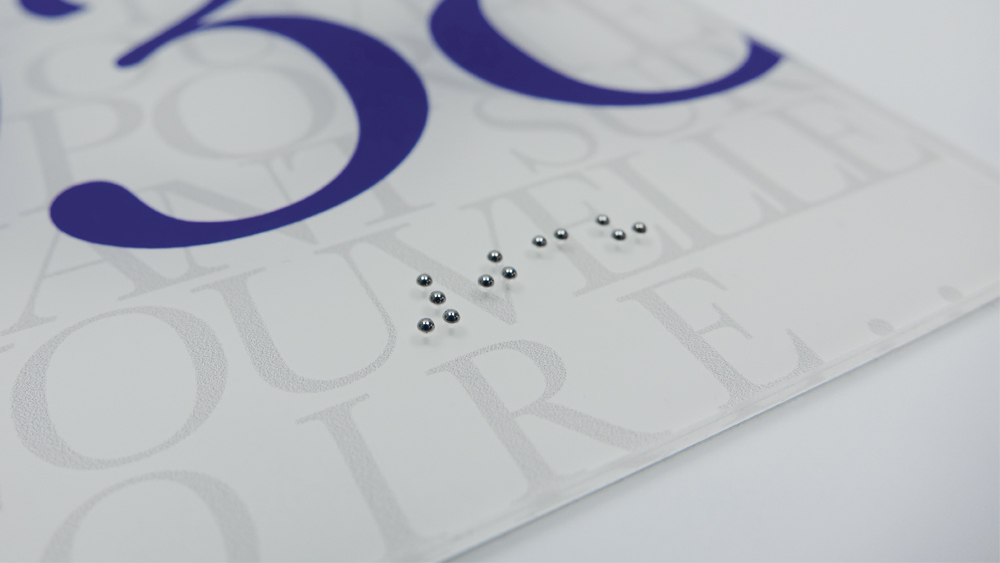
Public signage accessible to all thanks to the installation of signage plates with Braille and/or raised markings, adapted for visually impaired people.
icon-custom-engraved-plates-standard
Take the time to rely on the best standards
See our products
fast-delivery-company-branding-icon

express order and delivery in less than 10 days

With over 25 years of expertise, our mastery of braille sign manufacturing processes allows us to design products offering exceptional tactile readability and proven durability. You thus benefit from reliable signage that complies with regulatory requirements applicable to public buildings and industrial sites, guaranteeing improved accessibility for visually impaired individuals and people with reduced mobility.

What type of engraving should be chosen to ensure the readability of information and accessibility for people?

Technical Advantages & Depth Applications Environment & Resistance
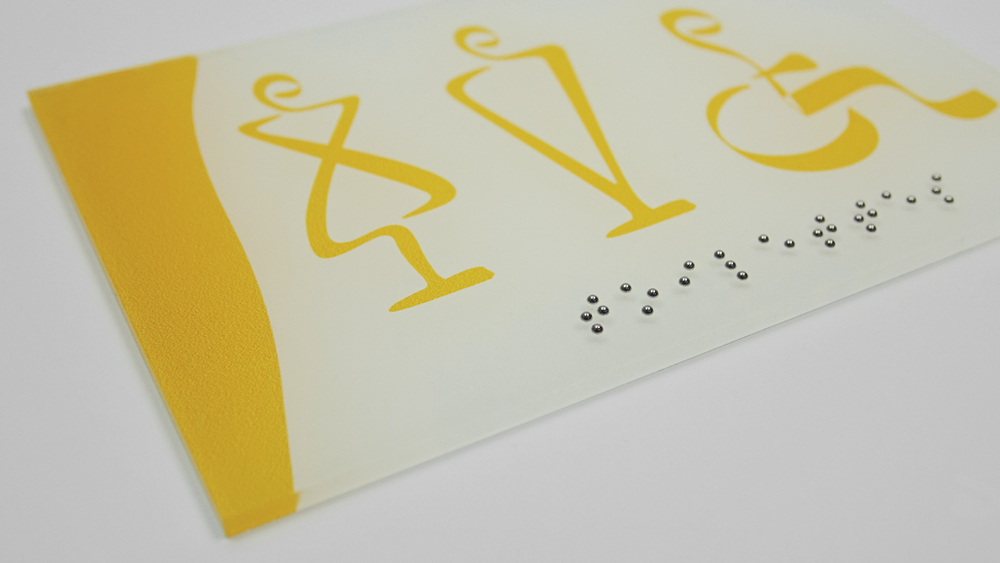
Insertion of Balls (Stainless Steel or Acrylic) Smooth and premium texture. The balls are securely set in the material, offering a perfectly spherical and pleasant feel, without any sharp edges. Offices, Hotels, Headquarters, Museums. Excellent for indoor use. High-end aesthetics.
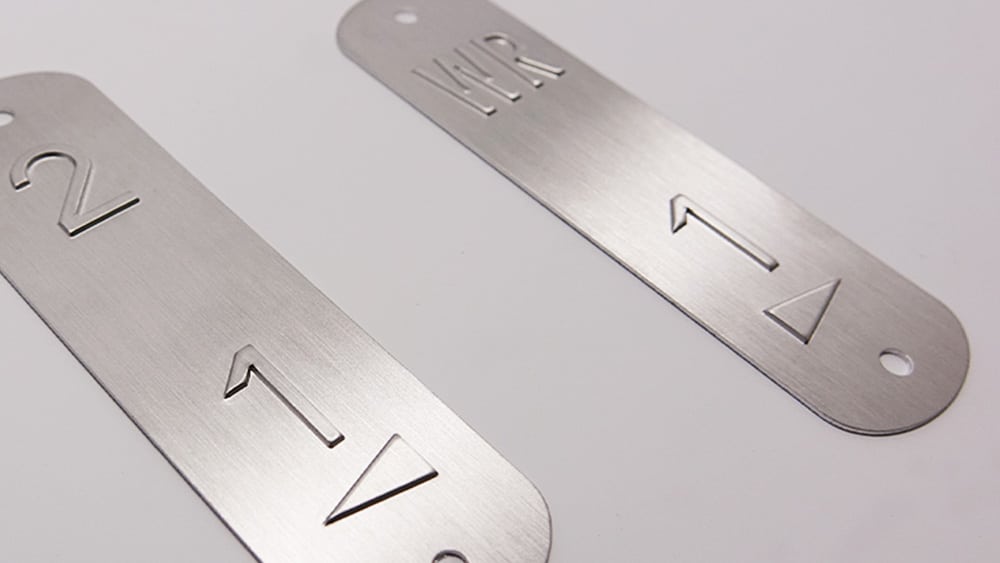
Mechanical Engraving / Milling Unalterable and one-piece. The relief is sculpted directly into the mass or by removing material around the points. No risk of element detachment. Industry, Hospital Environment, Transport, Outdoors. Maximum resistance to vandalism, weathering and intensive cleaning.
Etching on Bilayer Native contrast. Intaglio engraving revealing the color of the material's core (e.g., black surface, white core). Door signage, zone identification. Economical and lightweight. Primarily for indoor use.

Standards and compliance of your license plates

To ensure near-zero-defect production, we implement rigorous regulatory monitoring to guarantee high standards at every stage of our manufacturing processes. Each tactile sign panel is therefore strictly designed to comply with:

  • The NF X 50-783 standard: It governs accessibility standards (character dimensions, spacing, relief).
  • ERP accessibility recommendations: In accordance with disability law, to facilitate the autonomy of all.
  • ISO 9001 Certification: Our manufacturing process is certified, ensuring perfect consistency of production, from the first to the thousandth piece.

Personalized braille plaque

We support you in the development of specific models and the design of custom plates, perfectly adapted to your needs, by aligning our manufacturing processes with your graphic charter and technical constraints:

  • Custom cutting: Rectangular, oval or complex shapes according to your plans.
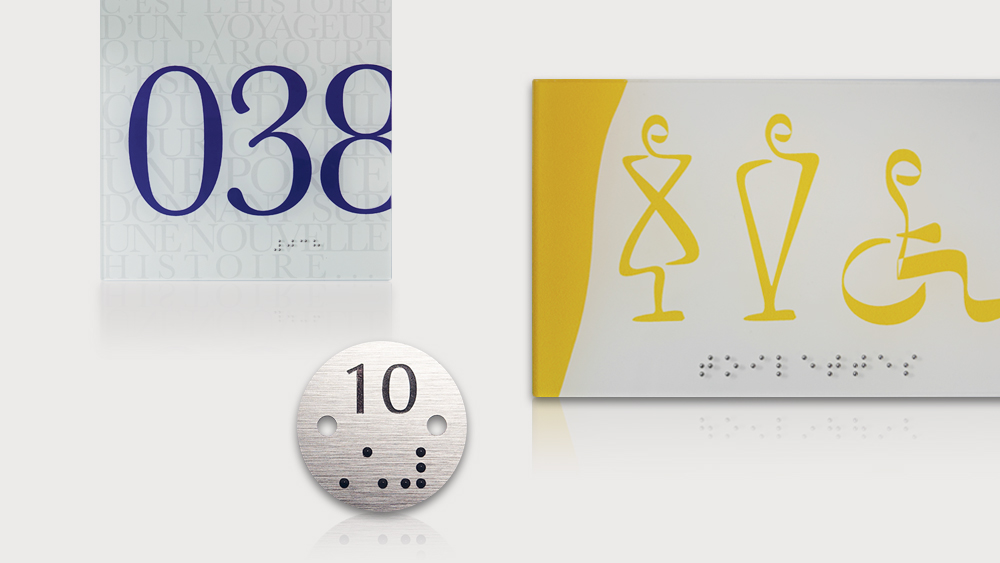
  • Mixed markings: We can combine raised (tactile) text, braille (balls or engraving) and visual elements (printed or engraved logos) on the same plate.
  • Fixing systems: High-performance structural adhesives or countersunk holes for a non-removable mechanical fixing.

The specific characteristics of tactile signage

Braille transcription is a profession in its own right that requires specific tools to avoid misinterpretations.

In Braille, there are no specific symbols for numbers. They are written with the same characters as the first letters of the alphabet (A=1, B=2, C=3…). For them to be read as numbers, they must be preceded by a specific numeral symbol (a prefix in the shape of an inverted L). Without this prefix, a blind person would read “Room B” instead of “Room 2”.

To avoid these common errors, we do not perform risky manual transcription. Our design offices are equipped with CAD/CAM software featuring professional transcription plugins (such as TypeEdit or Gravostyle). This guarantees an accurate conversion of your texts into standardized braille before they go into production.
Request Quote

Application areas :

  • Public establishment (leisure and culture)
  • Local authorities
  • Town halls
  • Schools
  • Sports facilities
  • ...

Examples of Braille signage:

  • Directional plate
  • Door plate
  • Pictogram
  • Identification label
  • Information panel

Examples of achievements

FAQ

What is the regulatory installation height for a braille sign in a public building?

Between 0,90 m and 1,30 m from the ground. This is the required zone to ensure readability for a person standing, a person in a wheelchair, or a person of short stature.

Ball bearings or mechanical engraving: which technique should I choose depending on my use?

For aesthetics and tactile comfort in offices and hotels, choose stainless steel or acrylic beads, which offer a soft, premium texture. For demanding environments, such as sanitary facilities, areas prone to vandalism, or outdoor settings, opt for mechanical engraving into solid aluminum or stainless steel, or milling, which guarantee a permanent, one-piece message without the risk of beads detaching.

Is Braille relief resistant to hospital or industrial cleaning products?

Yes, provided you choose the right substrate. We recommend 316L stainless steel or anodized aluminum for these environments. Unlike UV printing or adhesive labels that disappear with solvents, our markings made by material removal or mechanical insertion are chemically inert and withstand frequent cleaning, including bio-cleaning.

Request for a quote for a braille sign

Braille sign standards: NF X 50-783 and accessibility

The NF X 50-783 standard is today the main reference for the design of braille plates and tactile signage intended for accessibility.
It falls within the broader framework of disability law and the obligations applicable to establishments open to the public (ERP), with a clear objective: to guarantee information that is legible, understandable and usable by blind or visually impaired people.

The role of the NF X 50-783 standard

The NF X 50-783 standard defines the design rules for tactile signaling devices.
It notably governs the size of the characters, the spacing, the relief of the braille dots and the coexistence between visual text, raised text and braille.
The objective is to ensure reliable reading by touch, without ambiguity or confusion, regardless of the conditions of use.

This standard also aims to harmonize practices in order to avoid approximate interpretations or incorrect transcriptions, which are common when braille signage is produced without specific expertise.

Braille sign placement and readability requirements

Beyond the content, the standard imposes precise implementation rules.
The recommended installation height for a braille sign is between 0,90 m and 1,30 m from the ground, in order to allow comfortable reading for both a person standing and a person in a wheelchair.
Visual contrast between the background and the text is also essential for visually impaired people.

The materials used must guarantee dimensional stability and sufficient durability to maintain the relief over time, even in the event of frequent cleaning or intensive use.

Compatibility with ERP accessibility requirements

The NF X 50-783 standard is fully integrated with the accessibility requirements for public access buildings (ERP).
It helps to meet regulatory requirements regarding the autonomy, safety and guidance of people with disabilities.

A compliant braille sign must therefore be designed from the outset, taking into account the support, the environment and the actual use.
Compliance with the NF X 50-783 standard guarantees accessible, durable and legally compliant signage, contributing to better inclusion in public and professional spaces.

Braille signs and disability law: what you need to respect

The installation of braille signs is directly in line with the disability law, which aims to guarantee the accessibility of buildings and services for people with disabilities.
For establishments open to the public (ERP), tactile and braille signage is not simply a comfort feature, but a regulatory requirement designed to ensure the autonomy, safety and orientation of blind or visually impaired people.

The regulatory framework of the disability law

The disability law requires public establishments to make their spaces accessible to all, without discrimination.
This includes access to information, understanding of places and the ability to find one's way independently.
Braille signs play an essential role in this system, particularly for identifying premises, floors, sanitary facilities, exits or services offered.

Braille signage must be consistent, legible and logically implemented to avoid confusion or loss of information for the user.

Braille plate design requirements

To comply with disability law, braille signs must respect several fundamental principles.
Braille must be transcribed correctly, with sufficient relief to allow reliable tactile reading.
Raised characters and visual text must be complementary, in order to meet the needs of blind, visually impaired and sighted people.

The materials chosen must guarantee good durability over time, without flattening of the relief or degradation due to frequent cleaning, particularly in public or hospital environments.

Installation and placement rules

The disability law also imposes rules on location.
Braille signs should be positioned at a height between 0,90 m and 1,30 m from the ground, allowing comfortable reading for all users, including wheelchair users.
They must be placed in the immediate vicinity of the elements they identify, without any obstacle or hindrance to handling.

Responsibility and compliance

Failure to comply with the obligations related to braille plaques may render the operator of the establishment open to the public liable.
Signage that complies with disability law not only contributes to respecting the legal framework, but also to better inclusion and a responsible and professional image of the establishment.
A rigorous design of braille plaques is therefore a regulatory issue as much as a human one.

Manufacturer of custom braille signs in metal: stainless steel, aluminum...

Using a manufacturer of custom metal braille signs allows you to meet the highest requirements for accessibility, durability and regulatory compliance.
In establishments open to the public, industrial sites or environments subject to strong constraints, the choice of metal is essential as a reliable and long-lasting solution for tactile signage.

Why choose metal for braille plates?

Stainless steel and aluminum offer mechanical and environmental properties particularly suited to braille signage.
Unlike more fragile materials, metal guarantees excellent durability of the relief over time, even in the event of repeated handling, frequent cleaning or prolonged exposure to humidity and chemical agents.

Stainless steel, particularly grade 304 or 316L, is preferred for demanding environments such as hospitals, industrial sites, outdoor areas or places subject to intensive cleaning protocols.
Anodized aluminum is a high-performance, lighter alternative, while maintaining excellent dimensional stability and good corrosion resistance.

Marking techniques adapted to metallic braille

The manufacture of metal braille plates requires controlled processes to guarantee optimal tactile reading comfort.
Mechanical engraving allows for the creation of a single-piece relief directly in the material, without the addition of any added elements, ensuring maximum durability and total resistance to vandalism.

The insertion of stainless steel or acrylic beads is also used for projects with high aesthetic requirements.
The balls are mechanically set in the metal support, providing a soft and perfectly spherical feel, in line with user expectations.
The choice of technique depends on the use, the environment and the expected level of constraint.

Custom-made braille signage compliant with accessibility standards

A specialist manufacturer supports each project by integrating regulatory requirements from the design stage.
The metal braille plaques are made in compliance with the transcription rules, dimensions, spacing and installation heights provided for by the regulations applicable to public establishments.

Customization allows for the adaptation of formats, cuts, fixings and the combination of markings, combining braille, raised text and visual text in a coherent and legible manner.

Sustainability and regulatory responsibility

Choosing a manufacturer of custom braille signs in stainless steel or aluminum means investing in durable, compliant and valuable signage.
Beyond complying with disability law, these plaques contribute to the autonomy of visually impaired people and reinforce the responsible and professional image of establishments.
A well-designed metal braille sign retains its effectiveness and legibility for many years, even under intensive use.

Marquage Moderne, a specialist in industrial and advertising marking, has been producing personalized plates and labels for professionals to meet their marking needs for communication, identification or regulations for over 20 years.