


Because an accident at work can happen quickly and sometimes take a serious turn in a company, you must not neglect the safety and preventive marking.
If accidents at work often come down to a fall or minor injuries related to the use/handling of work tools, it is advisable to put in place a appropriate signage.
Tools to implement
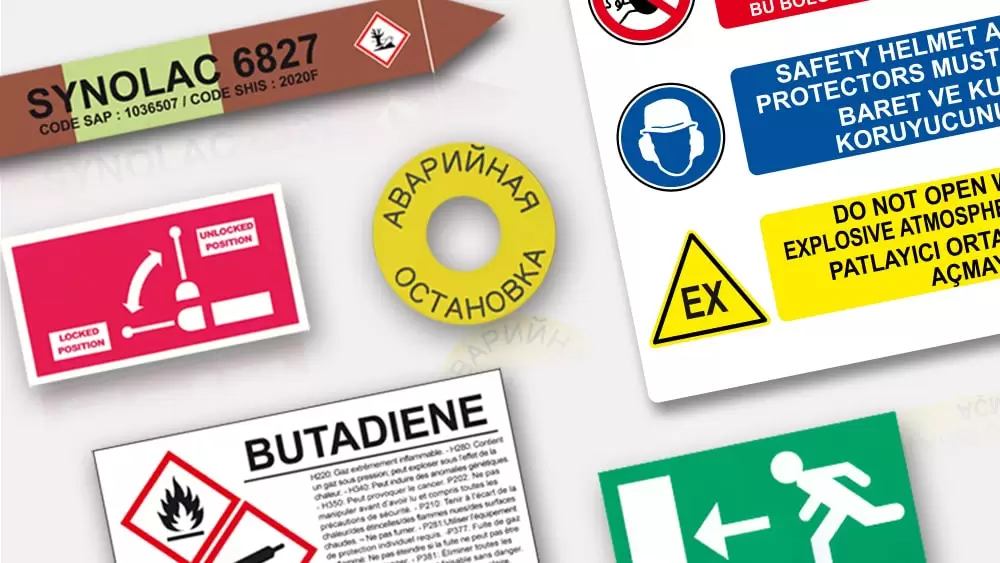
Taking the form of signs, plaques, safety labels , or stickers, regulatory marking is a key element in terms of prevention. From a legal standpoint, it primarily allows you to meet the regulatory requirements and standards in force in your sector of activity.
A signage clear is the best prevention tool for your employees in order to:
-First, of prevent factors/dangers in the company to avoid an incident due to improper handling.
-Then, from communicate safety instructions general conditions to be respected.
-Finally, ofinform in more detail on a particular safety point. For example, the handling of products such as: stocks of chemical and/or flammable products.
To meet specific needs, various supports can be produced: front panels for industrial machines, pipe markers and cable labels to identify fluids, electrical currents, etc.
Be aware that employers must ensure that their employees are trained on the meaning of this signage. They must also regularly clean, maintain, and check signs, light and sound signals, and emergency power supplies.
Codes to respect
For the sake of harmonization in order to use a universal language , safety marking is regulated by the INRS , whose mission is to ensure the safety of workers and preserve their health.
You want to improve informative marking at your workplace?
The INRS has for missionidentify occupational risks and highlight the dangers. The organization analyzes their consequences for the health and safety of employees. It must also disseminate and promote the means of controlling these risks within companies. The IRNS also advises you on the implementation ofaccident prevention actions.
In some sectors , a marking system is also mandatory . For fluid markings , for example, regulations must be followed. You can find these regulations on the AFNOR (French Standardization Association) website, which publishes French standards.
And the pictograms, in all this…
The pictograms (or graphic symbols) used for health and safety are standardized . The color code and shape of the symbols indicate whether they represent a prohibition, obligation, or warning of risk or danger. Specific pictograms also exist for fire safety information and emergency response.