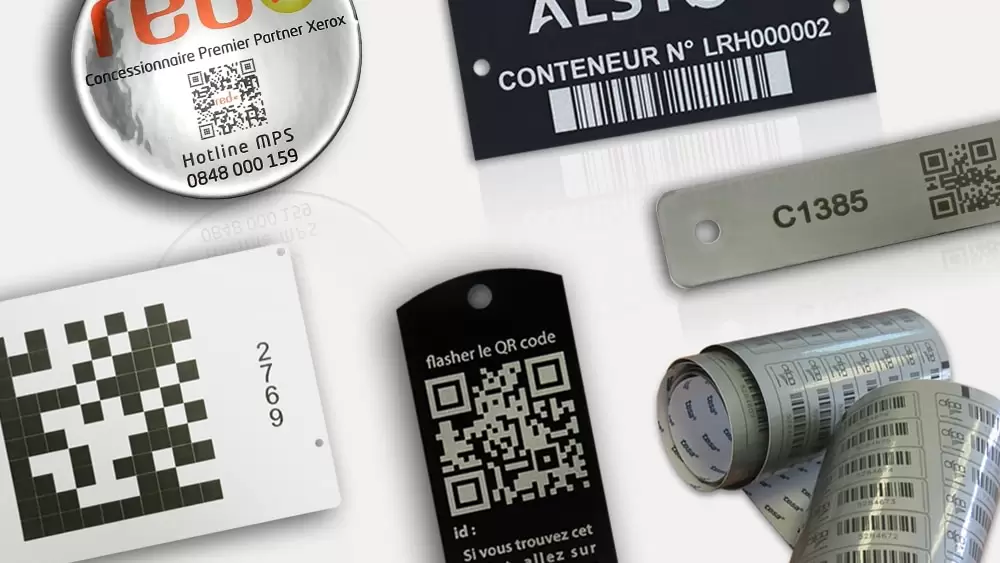


Barcodes are everywhere. While they initially appeared to meet a need for industrial identification , their use has become widespread to address the ever-increasing demand for traceability . And with the possibilities now offered by 2D barcodes , their use has become democratized and is part of everyday life, far beyond the industrial sector.
What is a barcode?
A barcode is a coded representation of alphanumeric data, decipherable using automated reading tools . There are two types: one-dimensional (1D) barcodes , those familiar bars of varying widths and spacing found on all our packaging, and two-dimensional (2D) barcodes , which take the form of a square symbol and are currently very popular. There are three reasons for this enthusiasm:
-Le matrix coding which allows a greater capacity of information to be encoded
- reduced footprint
-its technology camera reading, at 360°.
Thus, it can be read by technologies accessible to the general public via a smartphone or a webcam… In addition, its standardized ISO 18004 encoding contains up to 30% redundancy, hence its great ease of reading.
In this category, we still distinguish two models:
-Le datamatrix which emerged from the 2010s, rather used for industrial applications.
-Le QR code (abbreviation of English Quick Response) appeared in the 2000s. Its use has developed for much more extensive applications, fun and interactive, such as navigating to a website, watching a video, accessing practical information (on tourist sites for example), geolocating yourself and even making purchases!
They are also called, by abuse of language, "Flashcode", although this term refers to a French brand that has developed its own 2D code.
How is a barcode created?
Thus, 1D or 2D barcodes are created using specific software that generates them. They are then marked either by engraving ( laser or mechanical ) or by digital printing . The choice of marking technique will depend primarily on the material chosen: rigid plates (mainly aluminum, stainless steel, or PVC) or flexible adhesive vinyl labels. There is only one requirement for successful barcode marking : readability , achieved through high- quality marking, strong contrast with the background, and a clear margin (the empty space around the code).
Click here to learn more about our barcode products and see examples of our work.